

Your primary empathy style (cognitive, emotional, intuitive, or spiritual) determines how you naturally express empathy to yourself and others.
You can understand how you are wired by identifying your primary empathy style (though you may relate to other styles as well). Your main style is your default setting, how you naturally express empathy most of the time. Knowing your style is the starting place to appreciating how your own empathy functions and how you can comfortably give and receive caring. (Note that people with narcissism and others who have empathy-deficient disorders don’t have a style of empathy because they lack this quality.)
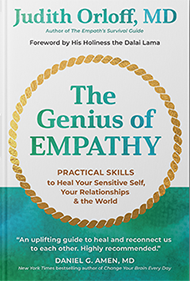
All styles of empathy can be healing in their own ways. The goal is to make the most of your assets and also experiment with different styles to broaden your options. In The Genius of Empathy, I write about the four types of empathy, their advantages and disadvantages, and how to balance them. Here is a brief description of each style for you to determine your empathy style.
Style 1. Cognitive Empathy: The Thinker/Fixer
If your primary empathy style is cognitive, you’re most comfortable with a concrete, cerebral approach to emotions. Consider this style “thinking empathy.” You use your mind to understand others and wish the best for them. You are solution-oriented. You want to logically fix a problem with brain power but are frustrated if you can’t. You may respond to a friend in distress with “I understand that this situation is hurtful, and here’s what you can do about it” rather than “My heart feels for you,” and then give them space to express their discomfort.
Style 2. Emotional Empathy: The Feeler
If your primary empathy style is emotional, you empathize with others through your emotions. Consider this style “feeling empathy.” You have a big heart and are responsive to people’s needs. You feel everything, but sometimes to an extreme. Like me and many other sensitive empaths, you may be an emotional sponge whose body absorbs others’ distress as well their joy. Since emotions can be contagious, you are vulnerable to catching them.
Style 3. Intuitive Empathy: The Subtle Senser
If your primary empathy style is intuitive, your keen intuition and sensitivity let you read people and their nonverbal cues more easily. Consider this style “sensing empathy.” Your intuition senses if someone is being authentic or if they aren’t. You have strong gut feelings, ah-ha insights, knowings, or dreams. You also feel the positive and negative vibes that people emit. These vibes come from what Chinese medical practitioners call “chi,” or subtle energy, which extends inches or feet from the skin.
Style 4. Spiritual Empathy: The Mystic
If your primary empathy style is spiritual, you empathize with others through your spirituality. Consider this style “divining empathy,” which describes the process of connecting to spirituality (however you define it) to open your heart. For some, spirituality could be God, Goddess, nature, a creative intelligence, or the power of love. The divine is a stepping stone to your large, compassionate self. You become a vessel for Spirit as you give and receive empathy. In some spiritual traditions ego = edging God out, which you are less prone to do.
The most significant relationship you’ll ever have is with yourself. Knowing your empathy style provides a basic understanding of how to productively express caring and where you are off balance. This information lets you love yourself more and find a comfortable, healing mode of giving and self-care.
I sense other people’s true feelings and I have this bad habit of trying to fix my friends or families problems for them. I am working on trying to just hold space for them instead because sometimes all someone wants or needs is someone who just listens to them and let’s them feel heard.
What if you feel like your are strongly all of these things? Is that a thing?
Dr. Orloff says that you can have more than one (and all) of the empathy styles. But if you focus on each one and listen to your body/intuition there will probably one or two that will feel a bit stronger than the others. The difference may be very small.
I am definitely the Cognitive Empathy &The Subtle Senser
I also think think I am a equally tuned to cognitive, emotional and intuitive
Can you have a combination? Per Melissa above —
I am definitely a “fixer” = cognitive AND
I am “Emotional” = feeler.
I am “Intuitive Empathy” = Senser
If you have THREE does that mean you have 3 TIMES the level of empathy to deal with? Ugh – waiting on receiving your books I just ordered!
My primary style is definitely the feeler. Thank you for sharing this Dr.
I think I am a combination of 3. cognitive, emotional, intuitive